The Production of Cloud: Design Research on Swiss Data CentresYiqiu Liu, with Dorothee Hahn, Martin Kohlberger, Milica Topalović, Jakob Walter, Jan Westerheide
Data centres are among the most influential buildings of our time, yet the public debate about their architecture is still insufficient. Behind the metaphor of a weightless cloud lies a resource-intensive construction practice: Architectural “black boxes” are built in industrial zones and along infrastructure corridors, engineered for high power consumption, digital connectivity, and physical and cybersecurity. An ongoing series of ETH D-ARCH design studios on Switzerland’s data centre landscape investigates their social, spatial, and environmental ramifications, and the role of urban and territorial research and design in these transformations. The studios are embedded within the SNIS-funded research project The Production of Cloud, at the Chair of Architecture of Territory, ETH Zurich.
Materialising the Cloud
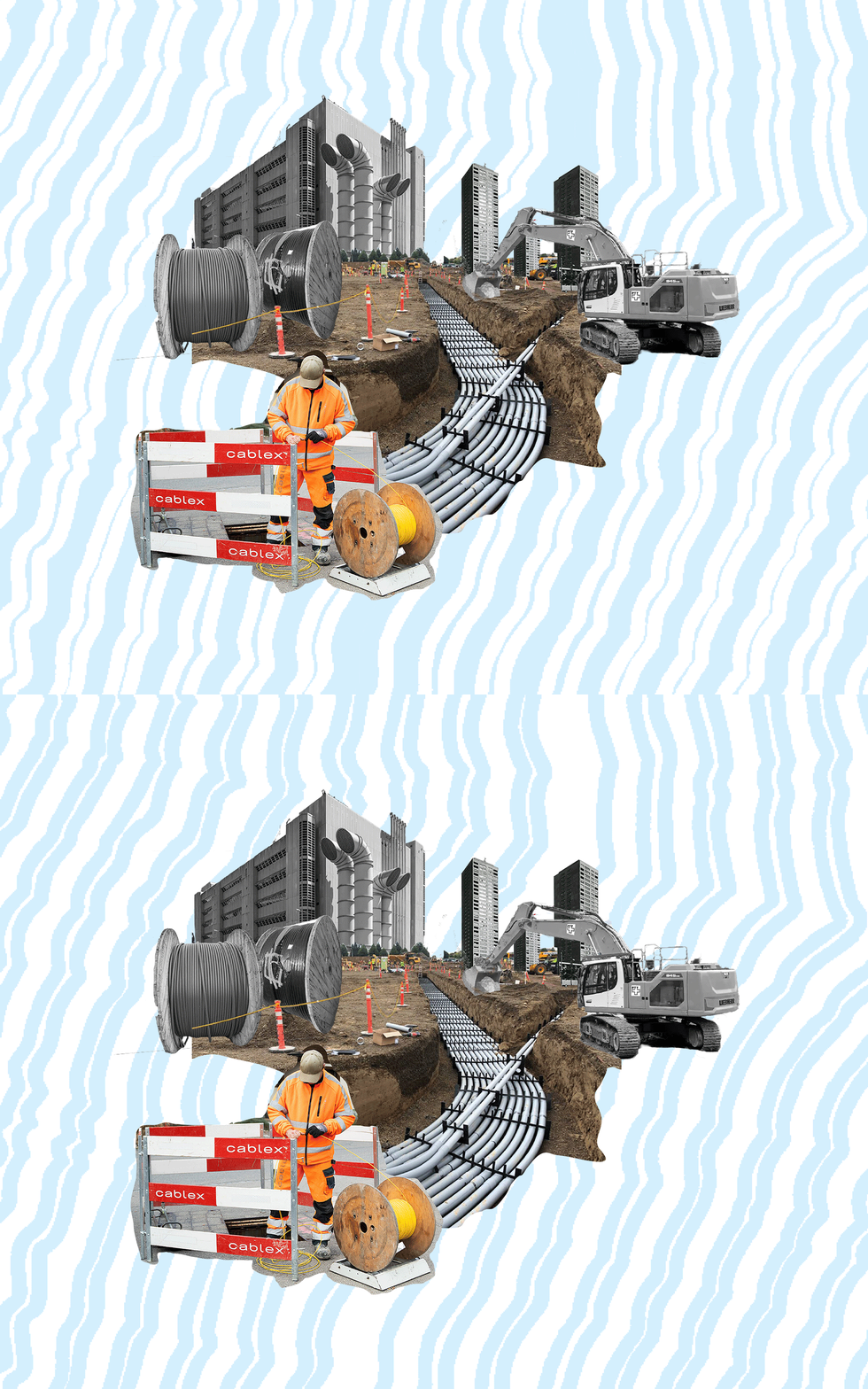
How are expanding AI infrastructures materialised and territorialised? Behind every apparently seamless digital interaction – a like, a click, a text message – lies a material assemblage of data centres, electricity networks, fibre-optic cables, cooling infrastructures, and resource landscapes. As the global AI race intensifies, these networks continue to expand faster than the appropriate regulatory frameworks that would be capable of governing them. While data centres are still largely treated as technical facilities, their effects extend far beyond the buildings, into energy systems, land markets, settlement patterns, and landscape ecologies. The Production of Cloud research project therefore asks how these infrastructures can be better understood, designed, and governed.


Tracing Digital Infrastructures Across Switzerland
In the frame of a studio series at ETH Architecture of Territory, students conducted ethnographic fieldwork on data centres across Switzerland and tested alternative planning and design approaches. In the autumn of 2025, Investigating Swiss Data Infrastructures studio catalogued architectural and organisational typologies of data centres, and traced their impacts across the territory. Through site visits, interviews, film, mapping, and thermal imaging, students followed electricity and heat flows, fibre-optic networks, and documented ownership, investments, planning processes, and local encounters. Their projects envisioned how such infrastructures, designed primarily as a dehumanised space for data hosting, might acquire a civic role. The proposals included visible waste heat networks in Glattbrugg, micro data centres enabling local digital sovereignty in cooperative housing estates in Geneva and Zurich, and new models of public data infrastructures that combine municipal data hosting function with social spaces such as physical and digital libraries.


Mapping the Zurich Data Centre Cluster
In spring 2026, Designing the Zurich Data Centre Cluster studio explored the clustering of data infrastructures in the Zurich region. Students started by creating a cartographic atlas of data centre clusters worldwide – from the Singapore-Johor region, Johannesburg and Santiago de Chile, to Beijing-Zhangjiakou, Northern Virginia, Frankfurt, and the Arctic Circle at Luleå. They continued by examining the Zurich metropolitan data centre cluster through the lenses of infrastructural concentration, energy demand, waste heat, land use, the Big Tech presence, digital sovereignty, and data ecologies. The resulting design scenarios tested ideas and measures including energy ceilings, new land use and location parameters, thermal territories localising energy production and consumption, municipal data labs, and home cloud systems. In addition to individual projects, students worked collaboratively to develop a common territorial constitution: a spatial and regulatory proposition on the future of the cloud infrastructures in the region of Zurich.


International Conversations and Comparisons
The studio projects form part of an ongoing international research process comparing three distinct modes of cloud production in Switzerland, Northern Virginia in the US, and Zhangjiakou in China. The research across the three regions addresses theorisation, policy, and spatial design of data infrastructures, and it combines design-led research with visual documentation, interviews, and cartography. The research will result in a policy brief, a special issue of ARCH+, and a series of curated events including an international symposium in Zurich in 2027.
See also

The Production of Cloud
Territorial and Architectural Strategies for AI’s Socio-Environmental Footprint

The Production of Cloud
Investigating Swiss Data Infrastructures
The Production of Cloud
Designing the Zurich Data Centre Cluster
