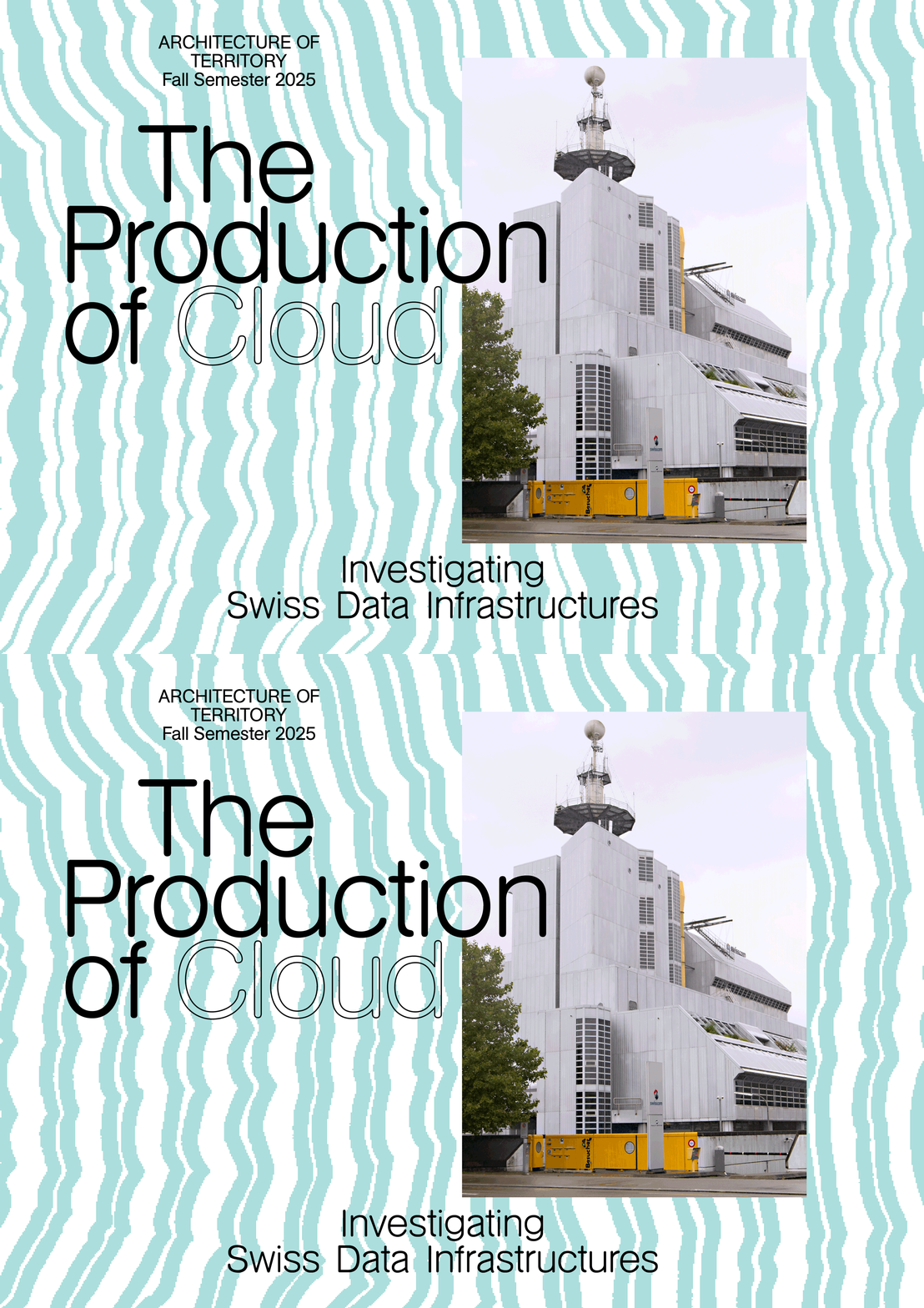
The Production of Cloud
Designing the Zurich Data Centre Cluster

Data centres, the most influential architectures of our time, are rarely designed as architecture, or with critical engagement from architects. The image of a frictionless and immaterial data “cloud” stands in contrast with the rather stark reality of networked black boxes scattered across the territory with few human employees, engineered for uninterrupted power supply, fibre-optic connectivity, and layered security. Single data centres often consume more energy than entire cities, emit vast amounts of waste-heat, and have limited material reuse. In different parts of the world, due to their energy and water consumption, communities are organising against their construction. As a result of the global AI race, data centre energy demand in Europe is projected to triple by 2030—becoming an obstacle to energy transition.
The Swiss approach is striking: data here is seen as “the new gold,” a new strategic asset enabling unprecedented concentration of big tech infrastructures and facilities, second only to Ireland. The Zurich metropolitan region hosts one of Europe’s major data centre cluster and is undergoing rapid expansion, with new AI data farms in Dielsdorf, Volketswil, and beyond. A recent study projects that by 2030, Swiss data centres could consume up to 15 percent of the nation’s electricity. Data centres are often located in tax-advantaged jurisdictions, along infrastructure corridors, near corporate headquarters, and close to the financial hubs, while providing few jobs and limited public benefits. Their architecture is often reduced to a design of the envelope and its tectonic pseudo-qualities, while accepting, ironically, a building’s role as off-limits infrastructure—whose public role and environmental responsibility are effectively reduced to zero. The studio asks: is such an uncritical approach to data centre design something we should support?
At the same time, manifold cultural phenomena and political struggles accompany our digital acceleration: from anxieties over AI apocalypse to phone-free zones, and form personal data tracking to digital sovereignty. All of them ask for socially and spatially intelligent responses from architects.
The studio invites you to collaboratively develop a territorial design project on Zurich’s data landscape. We will begin by debating the following questions: What if a data centre were a sealed technical object, but an urban public actor—contributing energy, connectivity, information and space to its surroundings? Could a data centre function more like a library, a greenhouse, or a playground? Should citizen data—such as biometric identity and health records—be stored on Microsoft servers, as they currently are, or within socially owned digital infrastructures? And what spatial forms might those infrastructures take? Finally, how might personal choices—such as online-offline rhythms and selective data storage—contribute to healthier data ecologies?
The studio is structured in three phases: 1) comparative data center clusters mapping and urban analysis; 2) fieldwork and video reportage; and 3) a common map of the future of Zurich’s Cloud. During the first three weeks, you will work in groups researching international data centre clusters, from North Virginia to Beijing and Zurich. You will map the planetary geographies of data computing and the digital divide, comparing different regions to each other. In the second phase, your core task is to investigate—through fieldwork, interviews, video essays and design analysis—a data centre currently under construction in the Zurich region. Working across scales, all studio participants will collaboratively visualise Zurich’’ data center cluster, infrastructure using diverse cartographic methods, QGIS and modelmaking. You will explore future scenarios through spatial and policy prototypes.
The studio will result in a common territorial project for Zurich’s data centre landscape, that fosters a socially and environmentally just transition.
POWER TO THE PEOPLE
is a studio series at Architecture of Territory dedicated to improving the social and environmental outcomes of technological and sustainability transitions. The studio is affiliated with the Swiss Network for International Studies (SNIS) through the research grant “The Production of Cloud.”
PROCESS AND RESULTS
The work consists of investigative journeys and intensive studio sessions. Architecture of Territory values intellectual curiosity, commitment, and team spirit. We are looking for avid travellers and team workers, motivated to make strong and independent contributions. Our approach enables students to explore a range of methods pertaining to territory, including ethnographic fieldwork, drawing styles, and mapping techniques such as QGIS. Your results will be published as an online reportage on our website using journalistic writing and videography to explain your work. Experts and guests will guide us on that journey. Students work in groups of two to three.
EXCURSION: MUNICH
For the second Tuesday of the semester, we will travel to Munich to visit the Leibniz Supercomputing Centre and the exhibition City in the Cloud—Data on the Ground at the Architekturmuseum der TUM. Travel expenses of about 60 CHF will have to be covered by you.
CREDITS
The semester offers a total of 17 credit points: the Design Studio 14 KP and the Integrated Discipline (Planning) 3 KP.


See also

The Production of Cloud
Designing the Zurich Data Centre Cluster

Power to the People
Energy and Territory in the Rheinland

Kraftwerk Schweiz
Investigating Territories of Energy Transition

Projects on Territory
Power to the People
Building a Common Model

The Production of Cloud
Investigating Swiss Data Infrastructures

The Production of Cloud
Territorial and Architectural Strategies for AI’s Socio-Environmental Footprint