AtlasBeijing-Zhangjiakou, CNLuis Berka, Mika John, and Giovanny Flores Soto
The Beijing–Zhangjiakou cluster illustrates how the geography of digital infrastructure is reshaping existing territorial systems. A region historically known as Beijing’s agricultural and energy hinterland is now becoming a major site for data storage, cloud services, and AI computing. Enabled by renewable energy resources, transport connections, and national infrastructure policy, Zhangjiakou has emerged as a key node within China’s strategy to redistribute computing power away from dense metropolitan centres.
At the same time, this transformation reveals broader tensions. The expansion of data centres is often framed as part of a green digital transition, yet it unfolds in a region marked by water scarcity, environmental pressure, and uneven regional development. Zhangjiakou therefore offers a revealing case of how older landscapes of energy and extraction are being repurposed for the infrastructure of artificial intelligence.


National Strategy for Data Infrastructure

China’s digital infrastructure expansion is strongly shaped by state-led planning. The Zhangjiakou cluster must therefore be understood within the broader framework of the national “East Data, West Compute” (EDWC) strategy launched in 2022. The policy aims to redistribute computing infrastructure away from densely populated eastern metropolitan regions toward inland areas with greater availability of land and energy.
Under this strategy, China established eight national computing hubs, connected through high-capacity digital networks. The Beijing–Tianjin–Hebei (Jing–Jin–Ji) region forms one of these hubs, with Zhangjiakou designated as a major data centre cluster responsible for supporting computing demand from the capital region.

More broadly, EDWC reflects a state-directed effort to reorganise the geography of digital infrastructure by separating locations of data demand from locations of compute production, while integrating both through national infrastructure systems. In this model, the state coordinates multiple domains simultaneously, including transport development, energy infrastructure, renewable energy expansion, spatial planning, industrial policy, and AI governance, creating the territorial conditions required for large-scale computing infrastructure.


At the same time, researching these infrastructures presents several methodological challenges. During the investigation of the Zhangjiakou cluster, inconsistencies between different mapping platforms became evident. Global platforms such as Google Maps and Google Earth sometimes display inaccurate or incomplete spatial information, including misaligned street networks or blurred areas around data centre facilities. Chinese platforms such as Baidu Maps often provide more locally accurate positioning but can contain limited publicly accessible information about specific infrastructure sites.
Additional constraints arise from restricted access to certain Chinese websites and databases outside the country, which can limit the availability of official documentation or technical details. As a result, mapping the cluster required combining satellite imagery, policy documents, and manual verification across different platforms.
These limitations illustrate the broader challenge of studying strategically sensitive digital infrastructures using publicly available online tools, where spatial data, platform restrictions, and information asymmetries shape the research process itself.
From Hinterland to Big Data Node

Zhangjiakou is a prefecture-level city in Hebei Province northwest of Beijing, historically forming part of the capital’s wider hinterland. Its geography—characterised by higher elevation, cooler temperatures, open land, and strong winds—has long shaped its economic role and infrastructure development.

These environmental conditions have supported energy production and large-scale infrastructure. The region has historically supplied coal and other resources to the capital region and, more recently, has become an important site for large wind and solar installations. At the same time, Zhangjiakou lies within the semi-arid landscapes of northern China and is affected by seasonal dust storms and limited water resources, which introduce environmental constraints for water-intensive infrastructure such as large data centres.

SECURITY BELT
Zhangjiakou progressively establishes its role as a defensive buffer for Beijing.

STEAM RAILWAY
Rail infrastructure redefines Zhangjiakou’s position, linking it directly to Beijing’s expanding territorial network.

DEFENSE (COLD WAR)
The region is consolidated as a military stronghold, forming part of Beijing’s northern defense system throughout the Cold War period.

INDUSTRIAL BELT
Zhangjiakou shifts toward industrial development, integrating into Beijing’s expanding resource and production hinterland.

URBAN NETWORK INTEGRATION (BEIJING)
The region is incorporated into the Beijing–Tianjin–Hebei urban network, aligning infrastructure and development at a metropolitan scale.

HIGH-SPEED RAIL (BEIJING)
The high-speed rail link strengthens Zhangjiakou’s integration with Beijing, significantly reducing travel time and enhancing regional connectivity.

GREEN BELT
Zhangjiakou is incorporated into ecological protection strategies, forming part of a green buffer that supports Beijing’s environmental regulation and resource management.

GREEN ENERGY
Zhangjiakou develops into a major renewable energy base, supplying wind and solar power to the Beijing region and supporting its transition toward low-carbon infrastructure.


Historically, Zhangjiakou functioned as a strategic gateway north of Beijing, controlling important trade and military routes connecting the capital with Inner Asia. The opening of the Beijing–Zhangjiakou railway in 1909, one of China’s first independently built railways, further integrated the region into national transport networks.
After the establishment of the People’s Republic of China in 1949, the city became part of the state-led development system supporting the capital region, operating mainly as an industrial and energy hinterland supplying resources and electricity to Beijing.
Since the early 2000s, Zhangjiakou has undergone a new phase of transformation. Integration into the Beijing–Tianjin megaregion, the expansion of renewable energy infrastructure, and investments related to the 2022 Winter Olympics strengthened transport connections and regional visibility. The high-speed rail link to Beijing, opened in 2019, reduced travel time to under one hour and further intensified its integration with the capital.
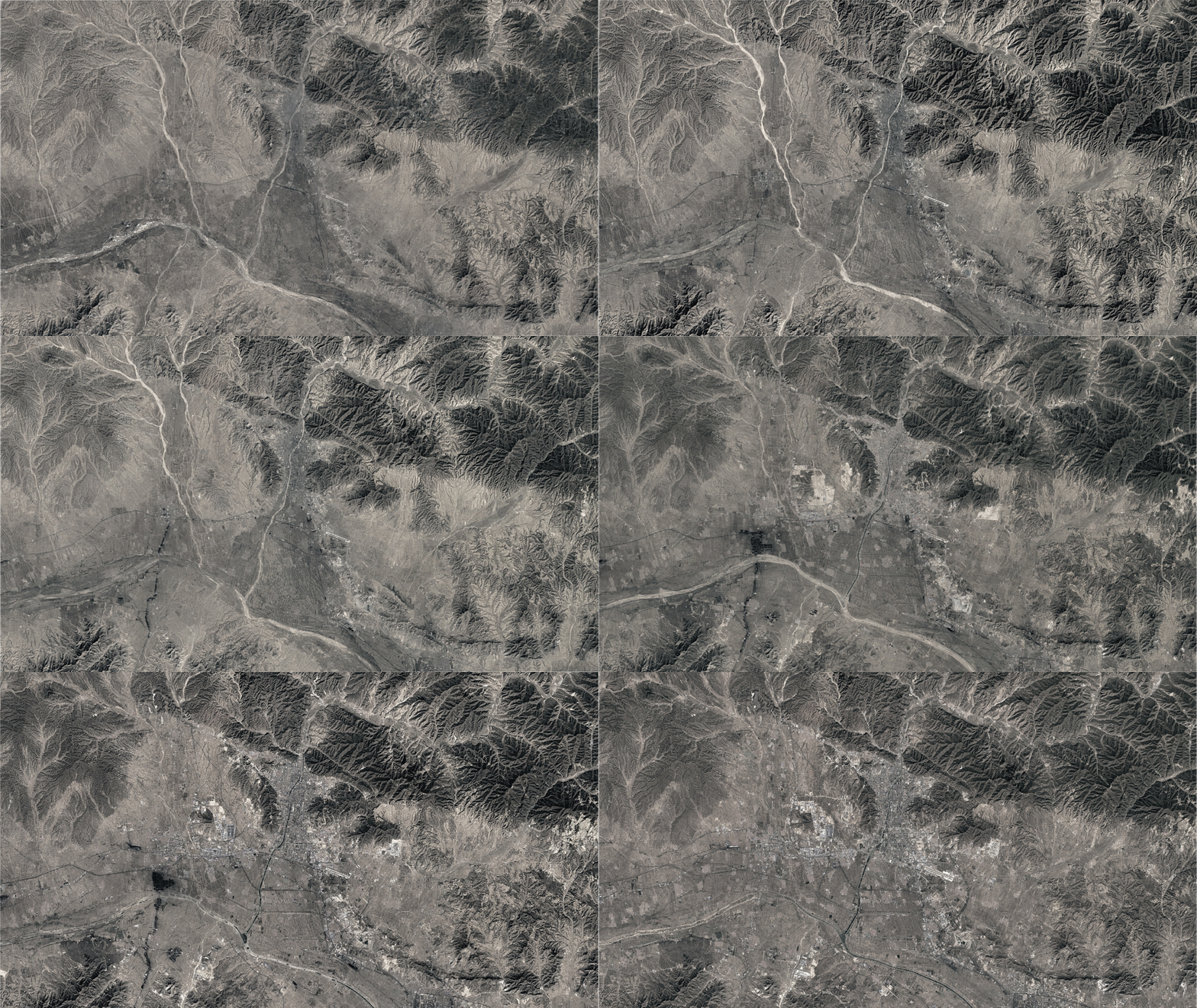
More recently, Zhangjiakou has entered another phase of development through China’s “East Data, West Compute” strategy, which positions inland regions with strong energy capacity as locations for large-scale data centres and AI computing infrastructure. In this context, the region’s earlier infrastructures—transport corridors, energy systems, and industrial landscapes—are increasingly being repurposed to support the expanding digital economy.
The Visible Infrastructure of AI
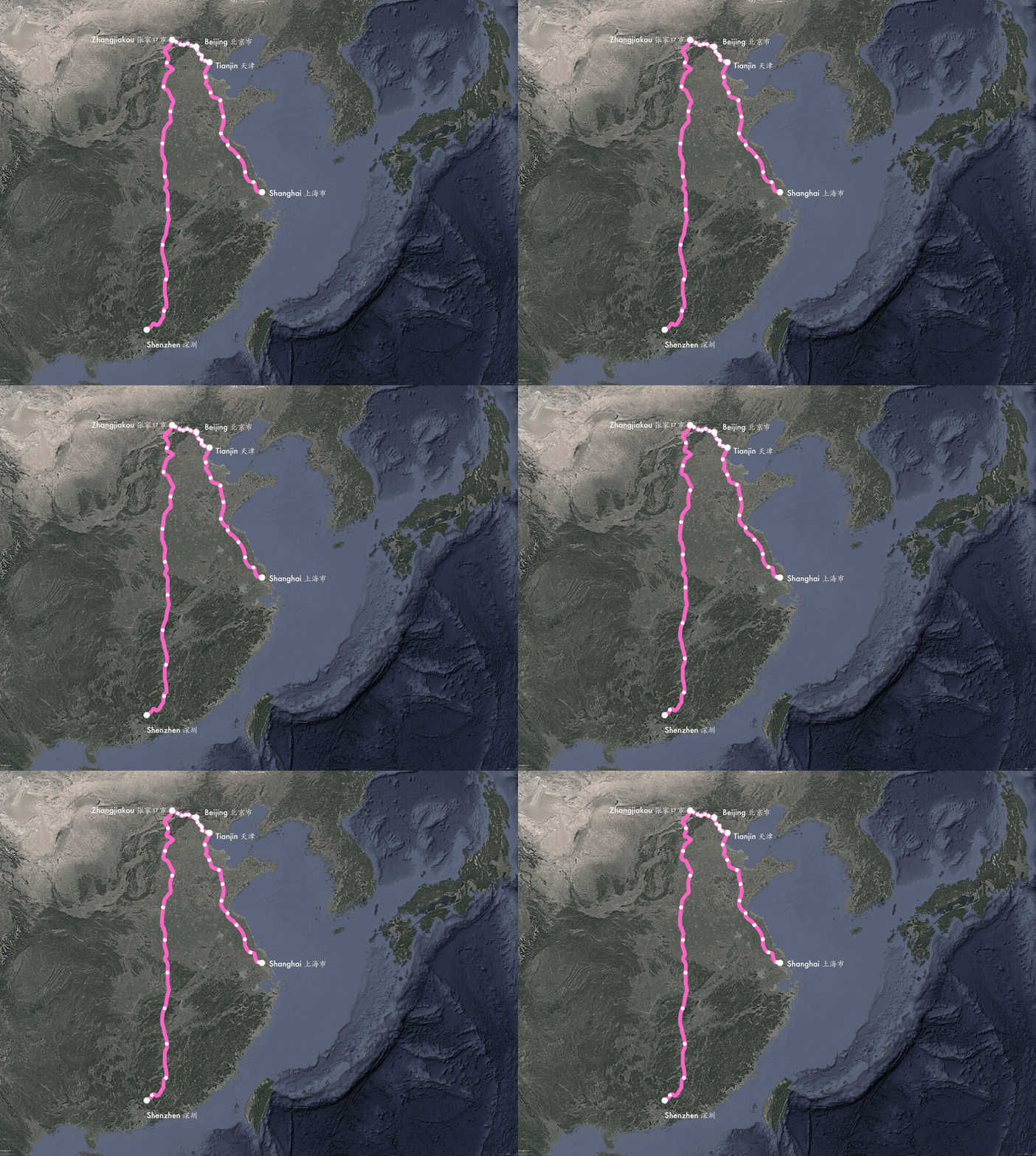
The emergence of the Zhangjiakou data centre cluster depends on the combination of digital connectivity, energy infrastructure, and spatial proximity to Beijing. Large-scale computing facilities require both high-capacity network connections and stable electricity supply, making infrastructure integration a key factor shaping the geography of data centres.
Digitally, Zhangjiakou is closely integrated into the Beijing–Tianjin–Hebei fiber backbone, one of northern China’s most important network environments. This proximity allows data centres in the region to process workloads for the capital while remaining physically located outside Beijing’s dense metropolitan area. The relatively short distance between the two cities also results in very low network latency. Distance-based estimates suggest one-way signal propagation times of roughly 0.8 milliseconds to Beijing and around 1.2 milliseconds to Tianjin, while connections to more distant centres such as Shanghai (~5.5 ms) or the Pearl River Delta (~10 ms) involve significantly higher transmission delays. As a result, Zhangjiakou is particularly suited for workloads serving Beijing and northern China’s digital markets, while long-distance traffic is typically handled by other national computing hubs.

The cluster itself is not a single facility but a distributed network of data centre campuses located in areas such as Zhangbei, Huailai, and Xuanhua. Major technology companies and telecom operators have established large installations in these zones, including Alibaba, Tencent, ByteDance-linked platforms, China Unicom, China Mobile, China Telecom, and Qinhuai Data (Chindata). These facilities form part of a broader computing ecosystem that supports cloud services, artificial intelligence training, and digital platforms connected to the Beijing metropolitan region.
To better understand the scale of this infrastructure, it can be compared with the Green Datacenter in Lupfig, Switzerland, one of the largest data centres in the Zurich region. The Lupfig facility operates with approximately 40 Megawatt (MW) of IT power, hosts around 80,000 servers, and occupies about 10,000 m² of data centre floor area. In contrast, the Zhangjiakou cluster operates at a much larger territorial scale. Estimates based on mapped data centre campuses suggest around 550,000 m² of data centre floor area and an estimated 4.4 million servers, supported by approximately 121,000 MW of IT power capacity across the wider cluster. 


While both systems operate with similar rack power densities and comparable energy efficiency levels (Power usage effectiveness values around 1.2), the comparison highlights the enormous spatial and infrastructural scale at which China is developing digital infrastructure. The Zhangjiakou cluster functions not as a single facility but as a regional computing landscape, integrating multiple campuses, energy production sites, and grid infrastructure across a large territory.
The rapid expansion of the Zhangjiakou data centre cluster raises important questions about the political and economic dynamics behind this new infrastructure landscape. Who finances the construction of these massive computing facilities and the energy systems that sustain them? And who ultimately benefits from their operation? Examining the actors involved, the flow of investment, and the distribution of advantages reveals how digital infrastructure is embedded within broader territorial and economic structures.
Actors and Existing Infrastructure


The development of the Zhangjiakou data centre cluster depends on a combination of energy infrastructure, grid connectivity, and state-supported policies. Large-scale computing facilities require vast and stable electricity supplies, making energy availability a key factor shaping the geography of data centres.
Zhangjiakou is surrounded by extensive renewable energy landscapes, including large wind farms, solar installations, and hydropower facilities connected to the regional grid. These resources, together with the region’s cooler climate and available land, make the area attractive for energy-intensive computing infrastructure.
A crucial enabling component is China’s ultra-high-voltage (UHV) transmission network, which links energy production sites with major urban demand centres. Key lines such as the Zhangbei–Xiong’an and Zhangbei–Shengli transmission corridors help deliver electricity across the Beijing–Tianjin–Hebei region.
The cluster is also supported by provincial development policies, including infrastructure investment, green credit programs, and preferential electricity arrangements. Together with land provision and planning approvals from local governments, these measures create the territorial conditions necessary for large-scale digital infrastructure.
INVESTORS
Funding for the Zhangjiakou data centre cluster appears to come from a combination of public investment, grid infrastructure spending, and corporate capital. Large-scale computing infrastructure requires significant upfront investment not only in server facilities, but also in electricity generation and transmission networks.
One example is the Zhongming Compute Center, reported with a total planned investment of about USD 2.8 billion (RMB 20 billion). An additional enabling cost is the construction of major energy infrastructure such as the Zhangbei–Shengli ultra-high-voltage transmission line, which required approximately USD 9.5 billion (RMB 67.86 billion) in investment.
The precise scale of state subsidies remains difficult to verify. Provincial policy documents describe support mechanisms such as industrial development funds, infrastructure loans, green credit programs, and government bonds, but they rarely disclose project-level subsidy amounts.
Electricity pricing structures also remain unclear. Official sources mention direct power supply arrangements and preferential electricity access, yet no verified tariff schedule for data centres in the Zhangjiakou cluster was identified in the sources reviewed here.
WHO BENEFITS?

The cluster primarily serves computing demand from Beijing and the wider northern China digital economy, absorbing workloads that require large processing capacity but do not need to be located directly inside the capital. These include cloud computing, e-commerce platforms, large-scale data storage, and artificial intelligence training.
Major technology companies and telecom operators have therefore established facilities in the region, including Alibaba, Tencent, ByteDance-linked platforms, China Unicom, China Mobile, China Telecom, and Qinhuai Data (Chindata). By 2023, Zhangjiakou hosted around 19 data centres and 1.34 million servers, and provincial sources estimate that by 2025 the cluster had expanded to roughly 1.72 million servers with around 29,100 P of computing capacity.
For Zhangjiakou, this expansion strengthens its role as a key node within China’s AI and cloud computing infrastructure, while Beijing benefits functionally by relocating energy-intensive computing facilities outside the dense metropolitan core.
At the same time, several aspects of this development remain difficult to measure. Reliable data on profits, employment effects, or market shares for major cloud providers is limited. Critical perspectives instead highlight potential environmental and territorial costs, particularly water stress in an already dry region and cases where data centre development has involved land expropriation and relocation.